This content has been translated automatically

Hans Rassmanns

A 20-year-old man was arrested for selling Bibles and spent nine years in six different concentration camps (born in 1916 in Kiel, died in 1992 in Schwalmtal)

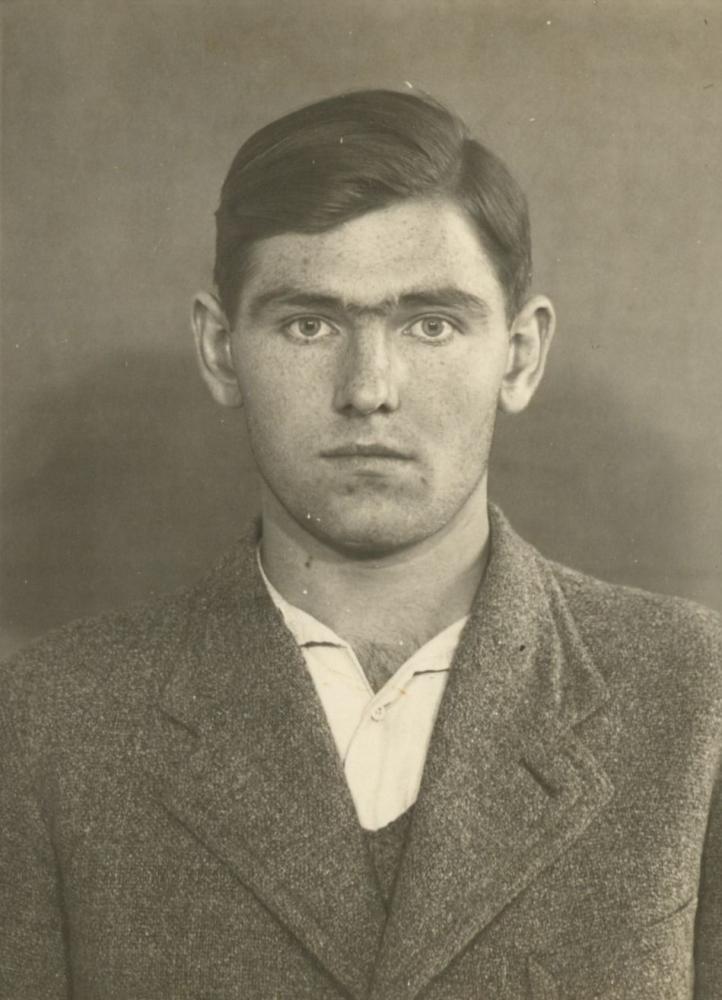
RW 0058 43361 0076 Portait Hans Rassmanns

Police photos of Hans Rassmanns, April 17, 1936

(Landesarchiv NRW - Abteilung Rheinland - RW 0058 Nr. 43361 Bl. 0076)

Hans Rassmanns was born on March 8, 1916, in Kiel, the son of Gerhard Rassmanns and Franziska Rassmanns (née Schulta). The family later moved to Mönchengladbach, where he worked as a locksmith and engraver.1 Little is known about his childhood.

Starting in 1928, he had contact with the “Bible Students,” who adopted the name Jehovah’s Witnesses in 1931. By 1933 at the latest, he had begun to actively promote his faith. As part of his missionary work, he visited the home of an NSDAP member in Rheydt on December 16, 1934, and attempted to sell a Luther Bible. Assuming his conversation partner was interested in the biblical message, he also offered to procure Jehovah’s Witnesses brochures produced abroad. The homeowner then took him, along with another party member, to the nearest police station. From the police’s perspective, however, this was merely a commercial offense, so they took no further action.2

Finally, on March 4, 1935, NSDAP members filed a complaint, whereupon the police arrested Hans Rassmann on his 20th birthday and searched his apartment. He was released only after signing the following statement: “I hereby undertake to refrain in the future from any subversive activity, in particular any participation in acts of high treason or treason against the state. Furthermore, I declare that I will not assert any claims based on the police measures taken against me.”3 At that time, Jehovah’s Witnesses were not yet presented with the later declaration for signature, which was intended to make them renounce their faith, but rather general statements of the kind also presented to communists or social democrats who had been taken into so-called protective custody under the “Decree of the Reich President for the Protection of the German People” and were then to be released. In addition, Rassmann’s passport was confiscated.

Reisepass von Hans Rassmanns Deckblatt

The passport of Hans Rassmanns, cover page, issued on July 13, 1934

(Landesarchiv NRW - Abteilung Rheinland - RW 0058 No. 43361 sheets 0081 and 0080)

Reisepass von Hans Rassmanns

The passport of Hans Rassmanns, inside pages, issued on July 13, 1934

(Landesarchiv NRW - Abteilung Rheinland - RW 0058 No. 43361 sheets 0081 and 0080)

Refused the order to join the Wehrmacht

On January 21, 1936, Hans Rassmanns refused a draft notice from the Wehrmacht. Two days later, during a police interrogation, he stated on record: “I did not comply with the order […] because, as God’s law states in 1 John 5:13, no murderer has eternal life abiding in him. Since I view universal conscription as a violation of the divine commandment, I refuse to comply with it, as I see universal conscription as a precursor to a new slaughter of humanity. […] I draw your attention to the fact that if you oppose me in my effort to obey God’s law by threatening me with reprisals, […] you reveal yourself as an enemy of the Almighty Creator.”4

Vernehmungsprotokoll von Hans Rassmanns

Interrogation protocol of Hans Rassmanns from January 23, 1936

(Landesarchiv NRW - Abteilung Rheinland - RW 0058 Nr. 43361 Bl. 0011)

On Easter Sunday, April 12, 1936, he went door to door proselytizing on Alleestraße in Mönchengladbach, but just a few days later, on April 17, 1936, he was arrested again. At the police station, he refused to give the Nazi salute and told the officers that he would never stop preaching. After being taken for a military physical against his will, he refused to sign his military service card and to greet them with “Heil Hitler.” The Gestapo’s application for a preventive detention order stated: “Prolonged preventive detention is absolutely necessary for Rassmann, who is a thoroughly nasty fellow. He has declared on record here that he will continue this activity again and again, since one must obey God more than men.”5 In a further letter dated May 7, 1936, it was stated: “It therefore seems appropriate to treat him with the utmost severity in the concentration camp and, under certain circumstances, to assign him immediately to the penal company.”6 Upon his admission to the Esterwegen concentration camp in the Emsland region on May 9, 1936, the Gestapo wrote to the camp administration, instructing them to “make an example of him that would serve as a warning to the others.”7

Schutzhaftantrag für Hans Rassmanns

Protective custody application by the Mönchengladbach-Rheydt state police for Hans Rassmanns, issued in April 1936

(Landesarchiv NRW - Abteilung Rheinland - RW 0058 Nr. 43361 Bl. 0016)

From the Esterwegen concentration camp to Sachsenhausen

A few months later, the Esterwegen concentration camp was closed, and the prisoners were transported in several convoys to Oranienburg near Berlin to work on the construction of the new Sachsenhausen concentration camp. Hans Rassmanns was on one of the last convoys to Sachsenhausen in October 1936. There, on February 15, 1937, the camp commander reported that Hans Rassmanns was a “cunning fellow” on whom “his previous upbringing” had left no trace.8 A request for a visit from his mother was denied. After the Düsseldorf Public Prosecutor’s Office dropped the charges against him on April 13, 1938, for “prohibited Bible Student activities,”9 he remained in “protective custody.” The Gestapo files contain documents from the period between July 1936 and January 1942 that document an extension of the “protective custody” for three months at a time. The Catholic prisoner Franz Ballhorn wrote in his diary entry dated December 31, 1941: “Hans Rassmanns, a Bible Student, was assigned to the penal company. For insubordination. He had refused to help burn wounded, still-living Russian prisoners in the crematorium.”10 As punishment, Hans Rassmanns was forced to work in a quarry. There, the prisoners were compelled to break rocks all day, load them onto carts, and then transport them at a run. As he later recounted, he would not have survived had he not sustained an injury—from September 9 to 18 and from November 23 to 28, 1941, he was in the infirmary of the Sachsenhausen concentration camp.11

Polizeifotos von Hans Rassmanns

Police photos of Hans Rassmanns, taken on April 17, 1936 in Mönchengladbach-Rheydt

(Landesarchiv NRW - Abteilung Rheinland - RW 0058 Nr. 43361 Bl. 0076)

From the Brandenburg subcamp Ketschendorf to Bergen-Belsen

In April 1944, he was transported to the Ketschendorf satellite camp (now Fürstenwalde/Spree), which was under the jurisdiction of the main camp in Sachsenhausen.12 The SS put the prisoners to work building the underground communications bunker Fuchsbau in Bad Saarow. He had hidden a small Bible in the camp, which he read in secret. One Sunday in May, Witali Kostanda, a Ukrainian forced-laborer, asked him about the purple triangle he wore on his clothing: “Hey, what’s a Bible Student?”13 Despite the language barrier, this marked the beginning of a series of biblical discussions that led Witali Kostanda to eventually embrace the faith of Jehovah’s Witnesses while in the concentration camp as well. At the end of January 1945, the front lines drew closer, and so the Ketschendorf camp was evacuated. Hans Rassmann and Vitali Kostanda were returned to the Sachsenhausen concentration camp.

Just one week later, both were transferred to the Bergen-Belsen concentration camp. In the now completely overcrowded camp in Lower Saxony, the prisoners lived in appalling, filthy conditions in barracks with leaky roofs through which rain poured. In the morning they received only a small piece of bread, and at noon a watery soup with a few rutabagas in it. The prisoners often had to stand for hours on the roll call square until some collapsed from exhaustion and died. The smell of death hung in the air, and every day the many dead prisoners were taken by horse-drawn carts to mass graves. That is why Hans Rassmanns said to his friend Witali Kostanda: “We have to get out of Bergen-Belsen, otherwise we’ll be corpses here in a few days too.”14

As a transport was being organized to take other prisoners to a work detail, Hans Rassmanns suggested: 

Listen, when he looks away, let's go stand with the ones who've been chosen, because it can't be any worse anywhere else.15

From the Farge subcamp in Bremen to Neuengamme

That is how they both ended up in the Farge district of Bremen, where the second-largest satellite camp of the Neuengamme concentration camp was located.16 

The prisoners were tasked with completing the construction of the 420-meter-long Valentin submarine bunker, which had an access point to the Weser River. Vitali Kostanda later reported that he had constantly suffered from hunger there and that the barracks had been completely infested with lice. After the bunker was damaged in Allied air raids at the end of March, work on it was halted. As Allied troops advanced, other satellite camps were evacuated and the prisoners were taken to the Farge concentration camp, where some 5,000 prisoners were now crammed into a very small space. On April 10, 1945, the camp was cleared.

Via one of the death marches, Hans Rassmanns reached the Neuengamme concentration camp and, after a few days, continued on to Lübeck Bay. There he was taken aboard the “Cap Arcona.” The ship was attacked by British aircraft on May 3, 1945, and went up in flames. How he managed to save himself from the burning ship onto a nearby small fishing boat is unknown. But by the time Witali Kostanda was able to swim to the boat and climb aboard, Hans Rassmanns was already in the boat’s small cabin. Using wooden planks, the prisoners rowed the fishing boat toward the shore, but since it was completely overloaded, it ran aground about 100 meters from the shore. At about the same time, British troops had taken the town of Neustadt. A British soldier then had a German prisoner of war row the men to the beach one by one in a rubber dinghy. He let the rescued men walk into the town of Neustadt, where they were housed in schools and barracks.17

A new start after the war

After spending a few days in Lübeck, Hans Rassmann and Vitali Kostanda got hold of two bicycles and rode them all the way to Mönchengladbach, where they found lodging at Hans Rassmann’s parents’ house. Since Soviet citizens were to be returned to the Soviet Union against their will under an Allied agreement, two British soldiers and a civilian showed up at the Rassmanns’ house one day to arrest Witali Kostanda, who was in an outdoor toilet in the courtyard at the time. Hans Rassmann told them that he had taken Witali Kostanda to the train station the day before, where Kostanda had departed for an unknown destination, whereupon the three visitors left the house. Shortly thereafter, he helped him obtain German identity papers under a false name at the office in Mönchengladbach-Rheydt.

In 1947, Hans Rassmanns was recognized as a victim of Nazi persecution, with his imprisonment confirmed, among others, by his fellow prisoner Otto Hartstang. Two years later, he received compensation for his imprisonment in the amount of 16,350 DM for 108 months and 16 days of imprisonment.18

Literature

Information is not translated

Schüngeler, Heribert: Widerstand und Verfolgung in Mönchengladbach und Rheydt, Mönchengladbach 1985

Footnotes

Information is not translated
  • 1

    Landesarchiv NRW – Abteilung Rheinland – Ger Rep 0114 Nr. 07015, Bl. 23, Verhörprotokoll von Hans Rassmanns in Oranienburg vom 16.03.1938.

  • 2

    Reiner Hermann: … hinter Stacheldraht und Gefängnismauern … – Zeugen Jehovas und Bibelforscher als Häftlinge in Bergen-Belsen, Hamburg 2021, S. 91f., 201, 230, 235.

  • 3

    Landesarchiv NRW – Abteilung Rheinland – RW 0058 Nr. 43361, Bl. 0009, Verpflichtungsschein von Hans Rassmanns in Gladbach-Rheydt vom 08.05.1935.

  • 4

    Landesarchiv NRW – Abteilung Rheinland – RW 0058 Nr. 43361, Bl. 0011, Vernehmungsprotokoll von Hans Rassmanns vom 23. Januar 1936.

  • 5

    Landesarchiv NRW – Abteilung Rheinland – RW 0058 Nr. 43361, Bl. 0012 B, Begründung des Antrags auf Schutzhaft.

  • 6

    Landesarchiv NRW – Abteilung Rheinland – RW 0058 Nr. 43361, Bl. 0021 B, Begründung der Inschutzhaftnahme des Graveurs Hans Rassmanns der Stapo Gladbach-Rheydt vom 7.05.1936.

  • 7

    Heribert Schüngeler: Widerstand und Verfolgung in Mönchengladbach und Rheydt, Mönchengladbach 1985, S. 311.

  • 8

    Landesarchiv NRW – Abteilung Rheinland – Signatur RW 0058 Nr. 43361, Bl. 0036, Führungsbericht des Lagerkommandanten Sachsenhausen über Hans Rassmanns vom 15.02.1937.

  • 9

    Landesarchiv NRW – Abteilung Rheinland – RW 0058 Nr. 04455, Bl. 2, Personalbogen von Hans Rassmanns [Ort ungenannt] vom 20.04.1938.

  • 10

    Franz Ballhorn: Die Kelter Gottes, Münster 1946, S. 84.

  • 11

    ITS Arolsen Archives 1.1.38.1, Veränderungsmeldungen im Häftlingskrankenbau des KL Sachsenhausen, Nr. 4089533, 4089542, 4089623, 4089629.

  • 12

    Da die Häftlinge täglich 1,5 km vom KZ-Außenlager in Ketschendorf (heute Fürstenwalde) zum Arbeitsplatz Fuchsbau in Bad Saarow marschieren mussten, ist das Außenlager auch unter dem Namen Bad Saarow bekannt. Zeitgenössisch wird es von Witali Kostanda durchgängig als Lager Ketschendorf bezeichnet, in dessen Gemarkung es sich auch befand. Siehe The United States Holocaust Memorial Museum Encyclopedia of Camps and Ghettos, Volume 1, S. 1265 (Bad Saarow; Abs. 13-16), S. 1396 (Spreenhagen).

  • 13

    Jehovas Zeugen Archiv Zentraleuropa: Transkript eines Zeitzeugen-Interview von Dieter Kury mit Witali Kostanda aus dem Jahr 2000, S. 8.

  • 14

    Jehovas Zeugen Archiv Zentraleuropa: Transkript eines Zeitzeugen-Interview von Dieter Kury mit Witali Kostanda aus dem Jahr 2000, S. 11

  • 15

    Jehovas Zeugen Archiv Zentraleuropa: Transkript eines Zeitzeugen-Interview von Dieter Kury mit Witali Kostanda aus dem Jahr 2000, S. 11.

  • 16

    KZ-Gedenkstätte Neuengamme: KZ Farge, https://www.kz-gedenkstaette-neuengamme.de/geschichte/kz-aussenlager/aussenlagerliste/bremen-farge/ (05.08.2025).

  • 17

    Jehovas Zeugen Archiv Zentraleuropa: Transkript eines Zeitzeugen-Interview von Dieter Kury mit Witali Kostanda aus dem Jahr 2000, S. 14.

  • 18

    Standesamt Schwalmtal Sterbeurkunde Nr. 16/1992.

Recommended citation for this article

Hans Rassmanns, in: Cap-Arcona-Portal (Publication date 04.06.2026), https://cap-arcona.atw.io/en/vertiefen/uebersicht/hans-rassmanns [2026]