
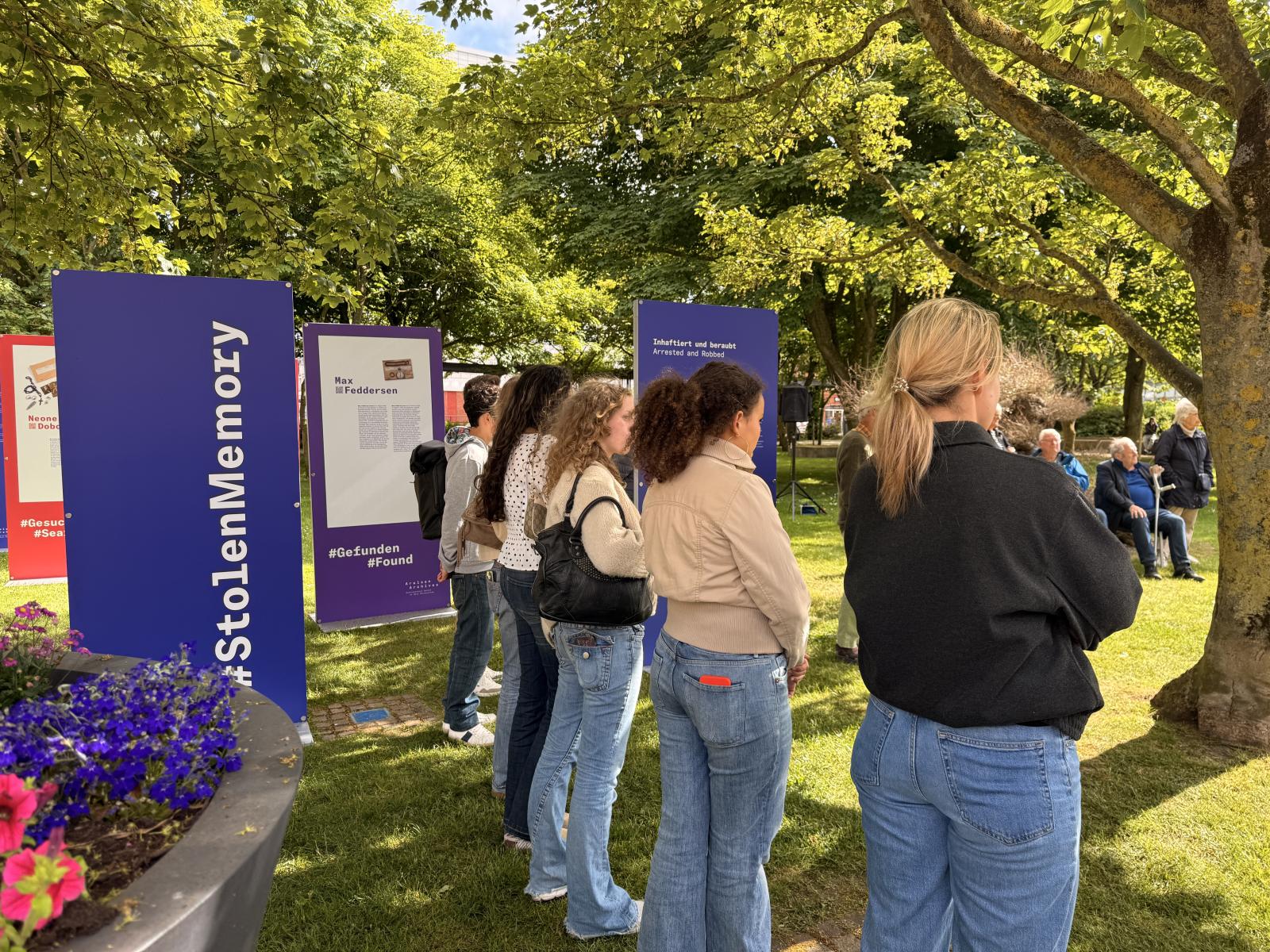
Students from the Sylt Gymnasium at the opening ceremony. Together with the Arolsen Archives, they had reconstructed the life stories of victims of persecution.
(Arolsen Archives / Photo: Nicole Lorentz)
Exhibition in Westerland
Through October 4, 2026, the #StolenMemory exhibition in Westerland’s Town Hall Park on Sylt commemorates, among others, Max Feddersen from Sylt, who lost his life during the bombing of the “Cap Arcona.” The Arolsen Archives are presenting the posters in collaboration with the Working Group on the Culture of Remembrance of National Socialism and with the support of the municipality of Sylt.
The event announcement states:
A wedding ring, a pocket watch on a chain: These are personal items that Max Feddersen was carrying when the Nazis arrested him in August 1944. A few days later, they deported the Sylt native to the Neuengamme concentration camp and took these items from him. An exhibition in Westerland commemorates the Sylt native and other victims of the Nazis.
One of the posters shows Max Feddersen’s ring and pocket watch: The exhibition posters focus on personal belongings of former concentration camp prisoners—so-called “effekten” that were taken from them upon their imprisonment. The goal of #StolenMemory is to return these items to the families of their former owners.
Max Feddersen worked for the Sylt Light Railway, was a member of the SPD, and served briefly on the Westerland municipal council. On August 22, 1944, he was arrested as part of the so-called “Aktion Gewitter.” With this Germany-wide wave of arrests, the Nazis responded to the July 20, 1944, assassination attempt on Adolf Hitler. The operation targeted former officials of the political parties of the Weimar Republic.
Five days after his arrest, the Nazis deported Max Feddersen to the Neuengamme concentration camp. There he was assigned prisoner number 43290.
After the evacuation of the Neuengamme concentration camp in April 1945, Max Feddersen was transferred to the “Cap Arcona”. On May 3, 1945, the British Royal Air Force mistakenly attacked the ship, and thousands of concentration camp prisoners died in Lübeck Bay. Max Feddersen also lost his life as a result of the attack. His body was later identified by his prisoner number.
Remembrance efforts on Sylt also include a project with the Sylt High School: In May 2026, students worked with the Arolsen Archives to reconstruct the life stories of island residents who were persecuted by the Nazis. Max Feddersen’s biography was also part of this project. The students presented their research at the exhibition’s opening event on June 5 and presented the poster honoring Max Feddersen to his family.
More information
(Source: Arolsen Archives)